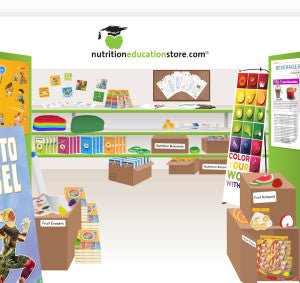



A Fresh Fruit and Vegetable Month Display: Name That Fruit or Vegetable
June is Fresh Fruit and Vegetable Month, and the activity to build the display around is a guessing game: read out a fact about a fruit or vegetable and have the room name it. It needs no equipment, it works on a crowd that comes and goes, and it rewards the one thing we actually want — variety.
The materials
- Banner with stand: Choose Wisely Banner — fruits and vegetables on forks, 24 x 67.
- Along the front of the table: Color Your World With Food Banner, 48 x 36.
- On the table: I Heart Fruits and Veggies Poster — a photo heart made of 40+ different fruits and vegetables, which is itself an argument for variety — on a tabletop easel.
- Brainstorming space: an easel with a whiteboard, poster board or large notepad, and markers.
- Prizes: Fruit and Vegetable Shaped Pens (also in a pack of 100) and Fork Stickers.
- Behind the table: fruit and vegetable balloons. Cheap, visible from across a hall, and children make their parents stop.
- For the game: the Name That Fruit and Veggie Game PowerPoint and Handouts — 25 fruits and vegetables, already written, if you would rather not assemble the trivia yourself.
Setting it up
Hang the Color Your World banner along the front of the table. Stand the Choose Wisely banner on one side and set the brainstorming easel on the other, so the table is framed. Put the balloons behind.
Top the table with the poster on its easel and fan the handouts in front. Line the prizes along the front edge, then step back and look at it from where a visitor would approach.
Activity 1: Name that fruit or vegetable
Assemble your facts before the event. Some examples to show the shape of it:
- This guitar-shaped winter squash is rich in alpha carotene, which diets high in have been linked to lower risk of heart disease and some cancers. (Butternut)
- These tart citrus fruits contain limonin, a compound being studied for its effects on health. (Lemons)
- This orange root is one of the richest food sources of beta carotene, which the body converts to vitamin A. (Sweet potato — and here is a bonus fact: most of what is sold as “yams” in American supermarkets is actually a sweet potato. True yams are a different plant entirely.)
- This tree-shaped vegetable is a member of the cabbage family. (Broccoli)
Gather a group at the booth, read the facts out and let people guess. Either hand out a prize per correct answer, or have people keep score and declare a winner at the end.
Two notes on making this work. Keep the claims honest — “linked to lower risk” rather than “fights cancer”, because an audience of health professionals will notice and because it is true. And pick unfamiliar produce as well as familiar: the point of the month is variety, and someone who leaves knowing what a kohlrabi is might buy one.
Activity 2: Getting more variety in
Move to the brainstorming board. Ask people which fruits and vegetables they actually eat. Are they getting enough? Review what MyPlate and the Dietary Guidelines recommend.
Then the real question, which is not “more” but “more kinds”: how could you eat a wider range in a week? Most people who eat produce eat the same four or five items on rotation, and widening that is both easier and more beneficial than increasing the total.
Record the answers. Give prizes for suggestions, especially practical ones — buy one unfamiliar thing per shop; pick by colour; use frozen for the ones that spoil before you get to them.
Free printable handout
Fruit and vegetable handout (PDF), free to print for the table.
More fruit and vegetable materials
- Fruit and Vegetable Challenge Tool Kit — an eat-more-produce contest, if you want this to run longer than a day
- Fruits and Veggies Poster Bundle — 6 posters, one line item
- Fruits Bulletin Board Kit and the Vegetables Bulletin Board Kit — 7 pieces each
- Kids Fruit and Vegetable Activity Set — felt salad set, 16 pieces
- Freedom From Chronic Disease Poster
- Fruit Photos Poster — 12 x 18
- Rainbow Salad Floor Decal
- Fruits and Vegetables Promotion — 76 products
- Fruit and vegetable posters
- Fruit and vegetable prizes
Related reading
- Getting out of a fruit and vegetable rut — a 30-food checklist, which is activity 2 in printable form
- How to help kids eat more vegetables
- Is that cut melon safe? — if you are serving fresh produce at the booth